Consider the Following Two dimensional Incompressible Flow Which Clearly Satisfies Continuity


Next: Velocity Potentials and Stream Up: Two-Dimensional Incompressible Inviscid Flow Previous: Introduction
Two-Dimensional Flow
Fluid motion is said to be two-dimensional when the velocity at every point is parallel to a fixed plane, and is the same everywhere on a given normal to that plane. Thus, in Cartesian coordinates, if the fixed plane is the  -
-  plane then we can express a general two-dimensional flow pattern in the form
  | (5.1) |
 |
Let  be a fixed point in the - plane, and let
  and
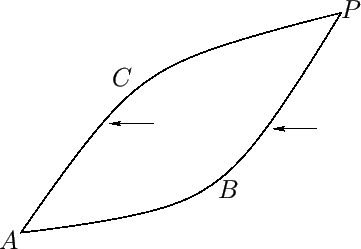
and  be two curves, also in the - plane, that join to an arbitrary point
  . (See Figure 5.1.) Suppose that fluid is neither created nor destroyed in the region,
  (say), bounded by these curves. Because the fluid is incompressible, which essentially means that its density is uniform and constant, fluid continuity requires that the rate at which the fluid flows into the region , from right to left (in Figure 5.1) across the curve , is equal to the rate at which it flows out the of the region, from right to left across the curve . The rate of fluid flow across a surface is generally termed the flux. Thus, the flux (per unit length parallel to the
  -axis) from right to left across is equal to the flux from right to left across . Because is arbitrary, it follows that the flux from right to left across any curve joining points and is equal to the flux from right to left across . In fact, once the base point has been chosen, this flux only depends on the position of point , and the time
  . In other words, if we denote the flux by
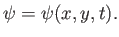
  then it is solely a function of the location of and the time. Thus, if point lies at the origin, and point has Cartesian coordinates ( , ), then we can write
 | (5.2) |
The function
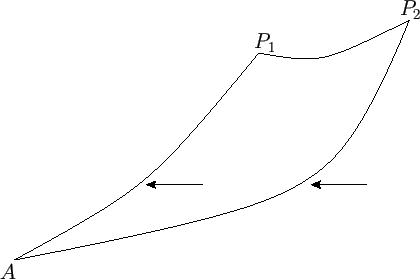
is known as the stream function. Moreover, the existence of a stream function is a direct consequence of the assumed incompressible nature of the flow. Consider two points,  and
and  , in addition to the fixed point . (See Figure 5.2.) Let
  and
and  be the fluxes from right to left across curves
  and
and  . Using similar arguments to those employed previously, the flux across is equal to the flux across plus the flux across
  . Thus, the flux across , from right to left, is
  . If and both lie on the same streamline then the flux across is zero, because the local fluid velocity is directed everywhere parallel to . It follows that
  . Hence, we conclude that the stream function is constant along a streamline. The equation of a streamline is thus
  , where
  is an arbitrary constant.
 |
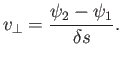
Let  be an infinitesimal arc of a curve that is sufficiently short that it can be regarded as a straight-line. The fluid velocity in the vicinity of this arc can be resolved into components parallel and perpendicular to the arc. The component parallel to
  contributes nothing to the flux across the arc from right to left. The component perpendicular to contributes
  to the flux. However, the flux is equal to . Hence,
 | (5.3) |
In the limit
 , the perpendicular velocity from right to left across
  becomes
  | (5.4) |
Thus, in Cartesian coordinates, by considering infinitesimal arcs parallel to the
- and -axes, we deduce that These expressions can be combined to give
 | (5.7) |
Note that when the fluid velocity is written in this form then it immediately becomes clear that the incompressibility constraint
 is automatically satisfied [because
 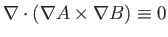 --see Equations (A.175) and (A.176)]. It is also clear that the stream function is undefined to an arbitrary additive constant.
 The vorticity in two-dimensional flow takes the form
where
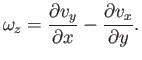 | (5.9) |
Thus, it follows from Equations (5.5) and (5.6) that
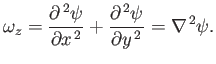 | (5.10) |
Hence, irrotational two-dimensional flow is characterized by
 | (5.11) |
When expressed in terms of cylindrical coordinates (see Section C.3), Equation (5.7) yields
 | (5.12) |
where
Moreover, the vorticity is

 , where
 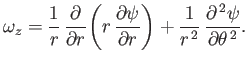 | (5.15) |
Next: Velocity Potentials and Stream Up: Two-Dimensional Incompressible Inviscid Flow Previous: Introduction Richard Fitzpatrick 2016-03-31
Source: https://farside.ph.utexas.edu/teaching/336L/Fluidhtml/node68.html
0 Response to "Consider the Following Two dimensional Incompressible Flow Which Clearly Satisfies Continuity"
Postar um comentário