Contemporary Logistics 11th Edition Chapter 4 Discussion and Review Answers
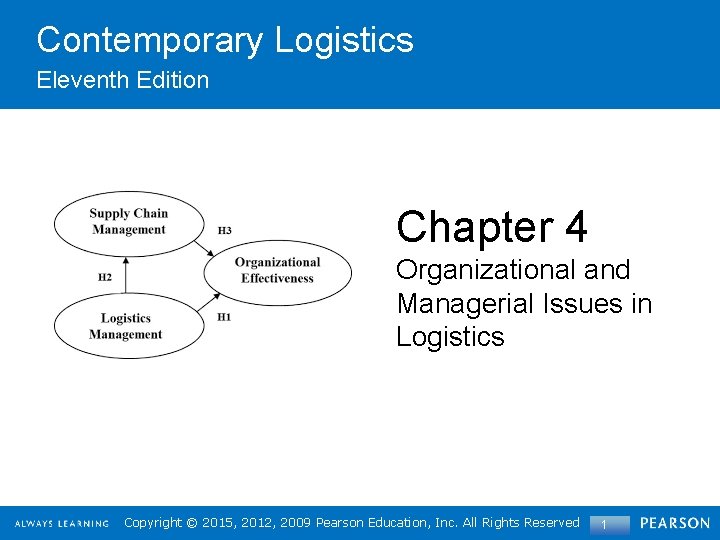
Contemporary Logistics Eleventh Edition Chapter four Organizational and Managerial Issues in Logistics Copyright©© 2015, 2012, 2009 Pearson. Educational activity, Inc. All. Rights. Reserved Copyright 1
Learning Objectives (i of ii) • To examine organizational construction for logistics • To learn nigh traditional and gimmicky organizational design for logistics • To explore productivity issues in logistics • To explore quality bug in logistics • To learn about means to manage theft and pilferage Copyright © 2015, 2012, 2009 Pearson Teaching, Inc. All Rights Reserved two
Learning Objectives (2 of 2) • To introduce you lot to the concept of logistics social responsibility • To talk over issues associated with reverse logistics • To describe programs designed to lessen the impact of terrorism on logistics systems Copyright © 2015, 2012, 2009 Pearson Instruction, Inc. All Rights Reserved 3
iv Overview of Class • Chapter 4 • In-Course Activities (seen on pwpt) – Participation Copyright © 2015, 2012, 2009 Pearson Education, Inc. All Rights Reserved 4
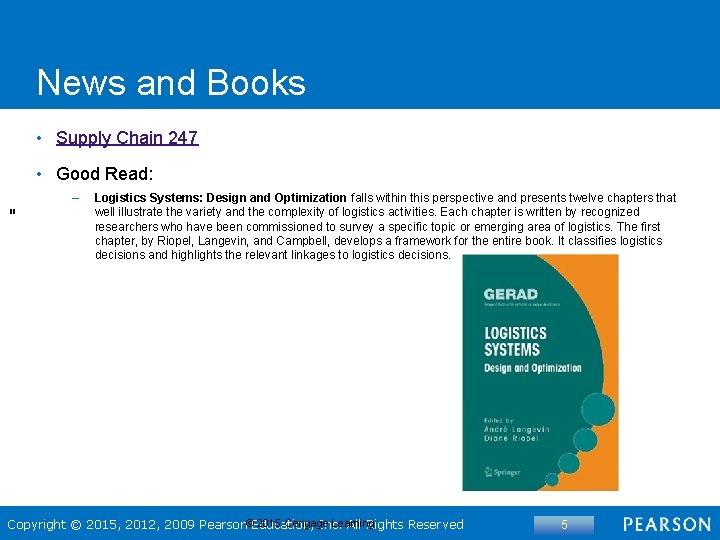
News and Books • Supply Concatenation 247 • Skillful Read: – " Logistics Systems: Design and Optimization falls within this perspective and presents twelve capacity that well illustrate the diversity and the complexity of logistics activities. Each chapter is written by recognized researchers who accept been deputed to survey a specific topic or emerging area of logistics. The first affiliate, by Riopel, Langevin, and Campbell, develops a framework for the unabridged book. It classifies logistics decisions and highlights the relevant linkages to logistics decisions. Copyright © 2015, 2012, 2009 Pearson© 2015 Cengage Learning Teaching, Inc. All Rights Reserved 5
Organizational and Managerial Bug in Logistics Key Terms (one of 2) • "C-level" position • Backlog capacity • Centralized logistics organization • Fragmented logistics structure • Container Security Initiative (CSI) • Importer Security Filing (ISF) rule • Community Trade Partnership Against Terrorism (C-TPAT) • ISO 9000 • Lean Half-dozen Sigma • Decentralized logistics arrangement Copyright © 2015, 2012, 2009 Pearson Educational activity, Inc. All Rights Reserved 6
Organizational and Managerial Bug in Logistics Key Terms (two of 2) • Logistics service quality • Logistics social responsibleness • Logistics uncertainty pyramid model • Malcolm Baldrige National Quality Award • Pilferage • Productivity • Reverse Logistics • Tachograph • Theft • Transportation Worker Identification Credential (TWIC) • Unified logistics structure Copyright © 2015, 2012, 2009 Pearson Pedagogy, Inc. All Rights Reserved vii
Organizing Logistics within the Firm • Ii central organizational logistics topics • Organizational structure • Organizational design Copyright © 2015, 2012, 2009 Pearson Education, Inc. All Rights Reserved viii
Organizational Structure for Logistics (1 of 3) • Two basic organizational structures are: • Fragmented logistics structure • Logistics activities are managed in multiple departments throughout an organization • Unified logistics structure • Multiple logistics activities are combined into and managed as a unmarried department Copyright © 2015, 2012, 2009 Pearson Education, Inc. All Rights Reserved 9
Organizational Construction for Logistics (2 of 3) • Two basic organizational structures for logistics departments are: • Centralized logistics organisation • Company maintains a unmarried logistics department that administers the related activities for the entire company from the dwelling part • Decentralized logistics organization • Logistics-related decisions are made separately at the divisional or production group level and ofttimes in different geographic regions Copyright © 2015, 2012, 2009 Pearson Educational activity, Inc. All Rights Reserved x
Organizational Construction for Logistics (3 of 3) • Job title or corporate rank • Leading border organizations tend to head the logistics department by senior-level personnel • More often than not excluded from holding a "C-level" position Copyright © 2015, 2012, 2009 Pearson Education, Inc. All Rights Reserved 11
Organizational Design for Logistics (one of 4) • Three principal types of organizational design include: • Hierarchical (functional) • Top-down flow • Matrix • Cross-functional responsibilities • Network • Process philosophy focused on combining tasks into valuecreating products and activities Copyright © 2015, 2012, 2009 Pearson Educational activity, Inc. All Rights Reserved 12
Organizational Design for Logistics (2 of 4) • Network organizational design is manifested in terms of: • Relevancy • Refers to satisfying current and emerging client needs • Facilitated by developing mutually beneficial relationships with key customers • At a minimum, these relationships should provide an agreement of customer needs and wants Copyright © 2015, 2012, 2009 Pearson Education, Inc. All Rights Reserved 13
Organizational Design for Logistics (3 of 4) • Network organizational pattern is manifested in terms of: • Responsiveness • Reflects the degree to which an organization can accommodate unique or unplanned client requests • Accomplished when the appropriate decision markers are provided with both relevant information and the potency to address unique or unplanned requests Copyright © 2015, 2012, 2009 Pearson Education, Inc. All Rights Reserved 14
Organizational Design for Logistics (four of four) • Network organizational design is manifested in terms of: • Flexibility • Is an system'south ability to address unexpected operational situations • Predicated on avoiding early commitment to an irreversible class of action Copyright © 2015, 2012, 2009 Pearson Education, Inc. All Rights Reserved 15
Managerial Problems in Logistics • Productivity • Quality • Risk • Sustainability • Complexity Copyright © 2015, 2012, 2009 Pearson Didactics, Inc. All Rights Reserved 16
Productivity • Tin exist defined as the amount of output divided by the amount of input • Provides insight into the efficiency with which corporate resource are being utilized Copyright © 2015, 2012, 2009 Pearson Education, Inc. All Rights Reserved 17
Three Ways to Meliorate Productivity • Reduce the amount of input while holding output constant • Increase the amount of output while holding input abiding • Increase output while decreasing input Copyright © 2015, 2012, 2009 Pearson Education, Inc. All Rights Reserved 18
Worker Productivity (one of 2) • Warehousing and transportation are heavily dependent on human labor • Human labor is an input (i. e. workers receive wages or salaries) • Productivity improvement efforts in logistics are often directed toward increasing the corporeality of output while property input abiding (workers resistant to suggestions regarding reduced wages or salaries) Copyright © 2015, 2012, 2009 Pearson Education, Inc. All Rights Reserved nineteen
Worker Productivity (2 of ii) • Logistics-operating employees are unionized in some areas • Warehousing facilities accept specific work rules • Warehouse employees can be monitored past direct supervision • Transportation employees (truck drivers) can exist monitored through technology, i. e. tachograph Copyright © 2015, 2012, 2009 Pearson Education, Inc. All Rights Reserved 20
Asset Productivity • Asset-related productivity concerns include: • Space utilization • Excess capacity • Unused available space • Tin can be unproductive as it may result in the purchase of boosted equipment or facilities which adds costs (input), but may not yield additional output resulting in a productivity pass up • Improving the output from existing assets • Increases productivity equally inputs remain abiding, but output is increased Copyright © 2015, 2012, 2009 Pearson Education, Inc. All Rights Reserved 21
Quality (1 of 9) • Logistics service quality • Relates to a firm'southward ability to deliver products, material and services without defects or errors to both internal and external customers 1 1 East. A. Morash, C. Droge, and S. Vickery, "Strategic Logistics Capabilities for Competitive Advantage and House Success, " Periodical of Business Logistics 17, no. 1 (1996): 1 -22. Copyright © 2015, 2012, 2009 Pearson Education, Inc. All Rights Reserved 22
Quality (2 of 9) • Quality in logistics involves merchandise-offs • If inferior logistic service quality, customers may perceive lower value • If superior logistic service quality than expected or required, system may be adding unnecessary cost • Organizations must endeavor to match the quality levels of the logistic services they provide with the expectations of their customers and the mural in which they operate. Copyright © 2015, 2012, 2009 Pearson Instruction, Inc. All Rights Reserved 23
Quality (iii of 9) • Vendors are expected to have quality programs • Vendors tin demonstrate commitment to quality to potential buyers through achieving and maintaining quality programme certification • ISO (International Standards Arrangement) 9000 certification is an example of a quality program certification Copyright © 2015, 2012, 2009 Pearson Education, Inc. All Rights Reserved 24
Quality (four of 9) • ISO 9000 • Is a gear up of generic standards used to certificate, implement, and demonstrate quality management and assurance systems • Is applicative to both manufacturing and service firms • Standards are intended to assist companies build quality into every core process in each department Copyright © 2015, 2012, 2009 Pearson Education, Inc. All Rights Reserved 25
Quality (5 of 9) • ISO 9000 • Firms demonstrating commitment to quality through training, reviews, and continuous improvement achieve initial ISO 9000 certification • Once certification is obtained, audits are conducted annually and organizations can be recertified every three years • Certification is credited with • an increment in client service • improved order accuracy • enabling enhanced costs analysis i i Paul D. Larson and Stephen G. Kerr, "ISO and ABC: Complements or Competitors? " International Journal of Logistics Direction 13, no. two (2002): 91– 100. Copyright © 2015, 2012, 2009 Pearson Pedagogy, Inc. All Rights Reserved 26
Quality (half-dozen of 9) • Six Sigma (or 6 standard deviations) • Is a quality focused methodology that emphasizes the virtual elimination of concern errors • Area covered under a normal curve is by half dozen standard deviations is 99. 999% • Approach suggests that there will be 3. 4 defects, deficiencies, or errors per one 1000000 opportunities • Can be practical to various logistics activities such as gild picking Copyright © 2015, 2012, 2009 Pearson Education, Inc. All Rights Reserved 27
Quality (vii of 9) • Six Sigma (or six standard deviations) • Benefits • Reduced costs • Reduced errors and waste material • Reduced wheel time • Drawbacks • Overcoming business organisation cultural barriers • Investing required resource (both homo and coin) • Gaining top management commitment Copyright © 2015, 2012, 2009 Pearson Education, Inc. All Rights Reserved 28
Quality (8 of 9) • Lean Six Sigma • Is a quality focused methodology that integrates Six Sigma with the Lean approach • Integrates the goals and methods of these ii approaches in pursuit of quality • Unique considering it recognizes that organizations cannot focus but on quality or speed • Emphasizes an organizational focus on improving quality as it relates to responsiveness Copyright © 2015, 2012, 2009 Pearson Pedagogy, Inc. All Rights Reserved 29
Quality (9 of nine) • Malcolm Baldrige National Quality Award • Recognizes organizations for their achievements in quality and performance • Established in the late 1980's • Restricted to firms headquartered in the United States • Eligibility initially limited to: • Manufactures, services, and modest businesses • Eligibility expanded to include: • Health care and educational institutions Copyright © 2015, 2012, 2009 Pearson Teaching, Inc. All Rights Reserved thirty
Risk (one of 9) • Tin be viewed as susceptibility to disruptions that could pb to a loss for a firm • Tin have a variety of forms as information technology relates to logistics management activities • Regularly occurring (or operational) risks, i. e. variability in demand or potential for a damaged shipment • Catastrophic risks, i. e. earthquakes or terrorist attacks Copyright © 2015, 2012, 2009 Pearson Education, Inc. All Rights Reserved 31
Gamble (2 of nine) • Logistics Incertitude Pyramid Model • Established to identify uncertainty sources that tin touch on the risk exposure for logistics activities • Identifies several types of doubtfulness including shipper, customer, carrier, control systems, and external Copyright © 2015, 2012, 2009 Pearson Educational activity, Inc. All Rights Reserved 32
Risk (3 of ix) • Terrorism is an instance of catastrophic risk • Terrorism can be defined every bit "an illegal use of or threat of force or violence made by a grouping or individual against a person, a company, or someone's belongings with a goal of menacing the target, oftentimes grounded in politics or ideology. " 1 Source: Terrorism, The American Heritage® Dictionary of the English language Language, 4 th ed. (n. d. ). Retrieved from Dictionary. com website: http: //dictionary. reference. com/browse/terrorism. 1 Copyright © 2015, 2012, 2009 Pearson Educational activity, Inc. All Rights Reserved 33
Run a risk (4 of 9) • September xi terrorist attacks have impacted logistics practices on a worldwide ground • Greater attention given to: • Processes • Procedures • Activities Copyright © 2015, 2012, 2009 Pearson Education, Inc. All Rights Reserved 34
Chance (five of nine) • Creation of the Department of Homeland Security (DHS) • Federal agency • Goals are • To prevent terrorist attacks in the U. S. • To reduce the vulnerability of the U. S. to terrorism Copyright © 2015, 2012, 2009 Pearson Instruction, Inc. All Rights Reserved 35
Take chances (6 of 9) • 22 carve up government entities were incorporated into DHS • Transportation Security Assistants (TSA) • Transportation Worker Identification Credential (TWIC) • Community and Border Protection (CBP) • Container Security Initiative (CSI) • Customs Trade Partnership Against Terrorism (C-TPAT) • Importer Security Filing (ISF) rule also known as " x+two" (instance in Table 4. two) Copyright © 2015, 2012, 2009 Pearson Education, Inc. All Rights Reserved 36
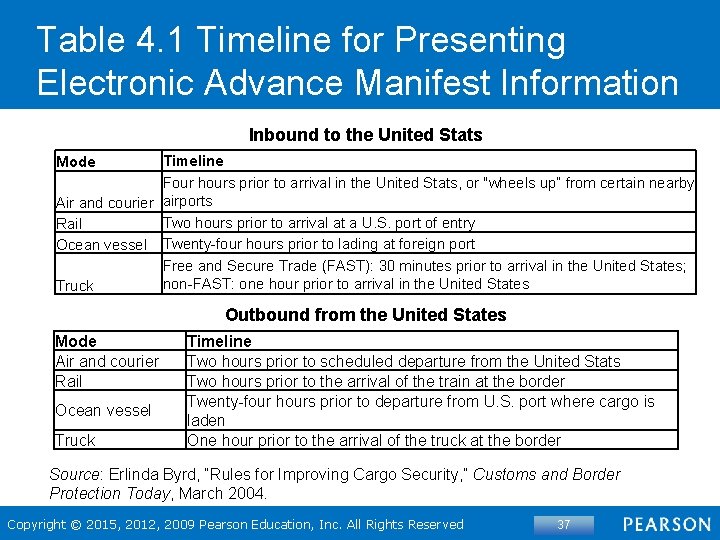
Table iv. 1 Timeline for Presenting Electronic Advance Manifest Information Inbound to the United Stats Timeline Four hours prior to arrival in the United Stats, or "wheels up" from certain nearby Air and courier airports Two hours prior to arrival at a U. Due south. port of entry Runway Ocean vessel Twenty-four hours prior to lading at foreign port Gratis and Secure Trade (FAST): thirty minutes prior to arrival in the United States; non-FAST: one hour prior to inflow in the Us Truck Mode Outbound from the United States Mode Air and courier Rails Ocean vessel Truck Timeline Two hours prior to scheduled departure from the United Stats Two hours prior to the arrival of the train at the border Twenty-iv hours prior to departure from U. S. port where cargo is laden Ane hour prior to the inflow of the truck at the border Source: Erlinda Byrd, "Rules for Improving Cargo Security, " Customs and Edge Protection Today, March 2004. Copyright © 2015, 2012, 2009 Pearson Didactics, Inc. All Rights Reserved 37
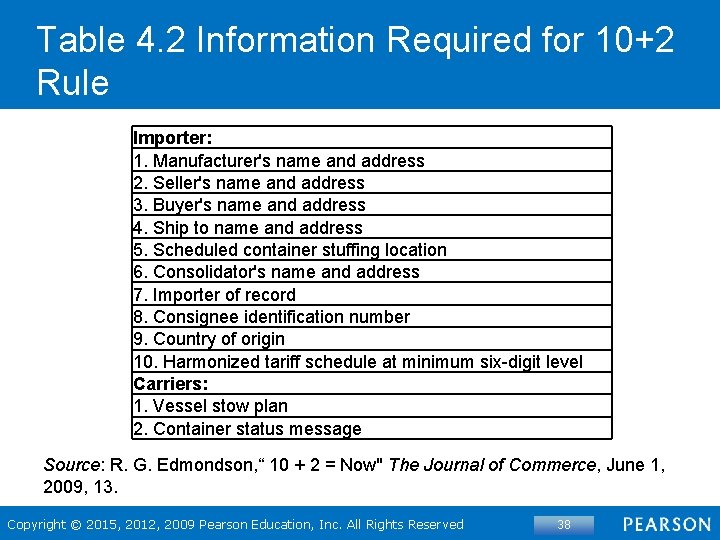
Table 4. 2 Information Required for ten+2 Rule Importer: i. Manufacturer'southward proper noun and address 2. Seller'due south proper noun and address 3. Buyer's name and address 4. Ship to name and address 5. Scheduled container stuffing location 6. Consolidator'due south name and address seven. Importer of record viii. Consignee identification number 9. Land of origin 10. Harmonized tariff schedule at minimum six-digit level Carriers: one. Vessel stow programme 2. Container status message Source: R. One thousand. Edmondson, " 10 + 2 = At present" The Journal of Commerce, June 1, 2009, thirteen. Copyright © 2015, 2012, 2009 Pearson Pedagogy, Inc. All Rights Reserved 38
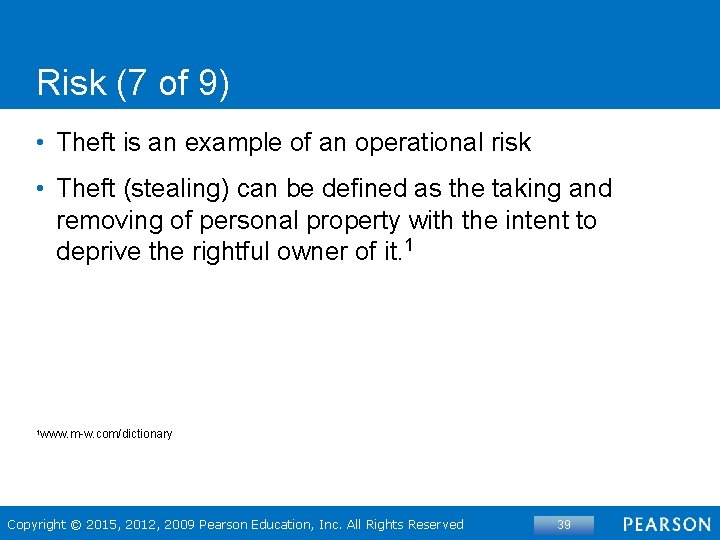
Run a risk (7 of 9) • Theft is an example of an operational risk • Theft (stealing) can be divers as the taking and removing of personal holding with the intent to deprive the rightful owner of it. one 1 www. k-due west. com/lexicon Copyright © 2015, 2012, 2009 Pearson Pedagogy, Inc. All Rights Reserved 39
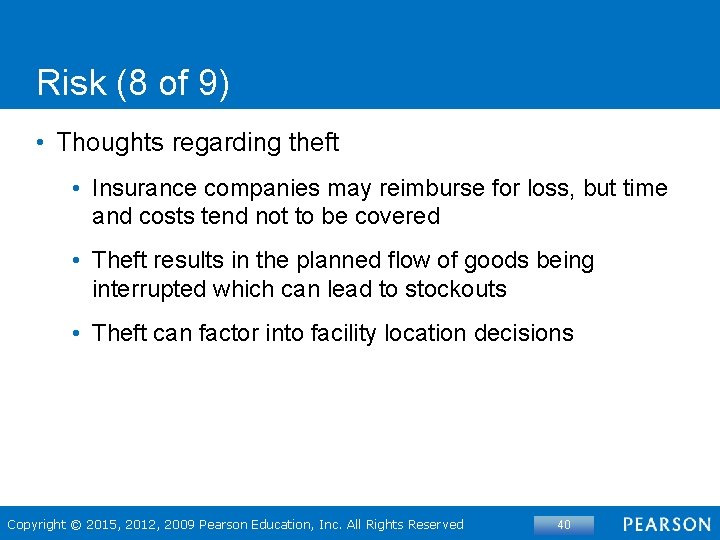
Chance (8 of 9) • Thoughts regarding theft • Insurance companies may reimburse for loss, but time and costs tend non to be covered • Theft results in the planned flow of appurtenances being interrupted which tin lead to stockouts • Theft can factor into facility location decisions Copyright © 2015, 2012, 2009 Pearson Education, Inc. All Rights Reserved 40
Adventure (9 of nine) • Thoughts regarding pilferage (employee theft) • Transportation and warehousing operations are specially vulnerable to pilferage • Managing pilferage begins with the hiring process • Zero tolerance pilferage policy • Proceed goods moving through the arrangement • Contempo increase in pirate attacks Copyright © 2015, 2012, 2009 Pearson Education, Inc. All Rights Reserved 41
Sustainability (1 of 3) • Logistics Social Responsibility • Corporate social responsibility bug that relate directly to logistics Source: Craig R. Carter and Marianne M. Jennings, "Logistics Social Responsibility: An Integrative Framework, " Journal of Business concern Logistics 23, no. 2 (2002): 145 -180. • Potential dimensions include: • Environment • Ethics • Diversity • Prophylactic • Philanthropy • Human rights • Others Copyright © 2015, 2012, 2009 Pearson Teaching, Inc. All Rights Reserved 42
Sustainability (2 of three) • Opposite logistics • Is the process of managing render appurtenances • Exceeds $100 billion in U. Southward. lonely • Can be iv -5 times more expensive than frontward logistics • Process can have 12 times equally many steps equally frontward logistics Copyright © 2015, 2012, 2009 Pearson Education, Inc. All Rights Reserved 43
Sustainability (3 of iii) • Reverse logistics process focuses on: • Why products are returned • How to optimize opposite logistics • Whether contrary logistics should exist managed internally or outsourced to a third political party 1 1 John Paul Quinn, "Are There Always Whatsoever Happy Returns? " Logistics Management, June 2005, 63– 66. Copyright © 2015, 2012, 2009 Pearson Didactics, Inc. All Rights Reserved 44
Complexity • Network complication • Is the growing number of nodes and the associated changes to the links in logistics systems • Procedure complexity • Centers on the haphazard evolution of processes, additions and modifications to processes over time, and/or irresolute process requirements • Range complexity • Centers on the implications associated with the increasing number of products that most companies continue to face in an try to differentiate themselves with their customers Copyright © 2015, 2012, 2009 Pearson Education, Inc. All Rights Reserved 45

46 Next Calendar week • Chapter 5 Copyright © 2015, 2012, 2009 Pearson Education, Inc. All Rights Reserved 46
Source: https://slidetodoc.com/contemporary-logistics-eleventh-edition-chapter-4-organizational-and/
0 Response to "Contemporary Logistics 11th Edition Chapter 4 Discussion and Review Answers"
Postar um comentário